
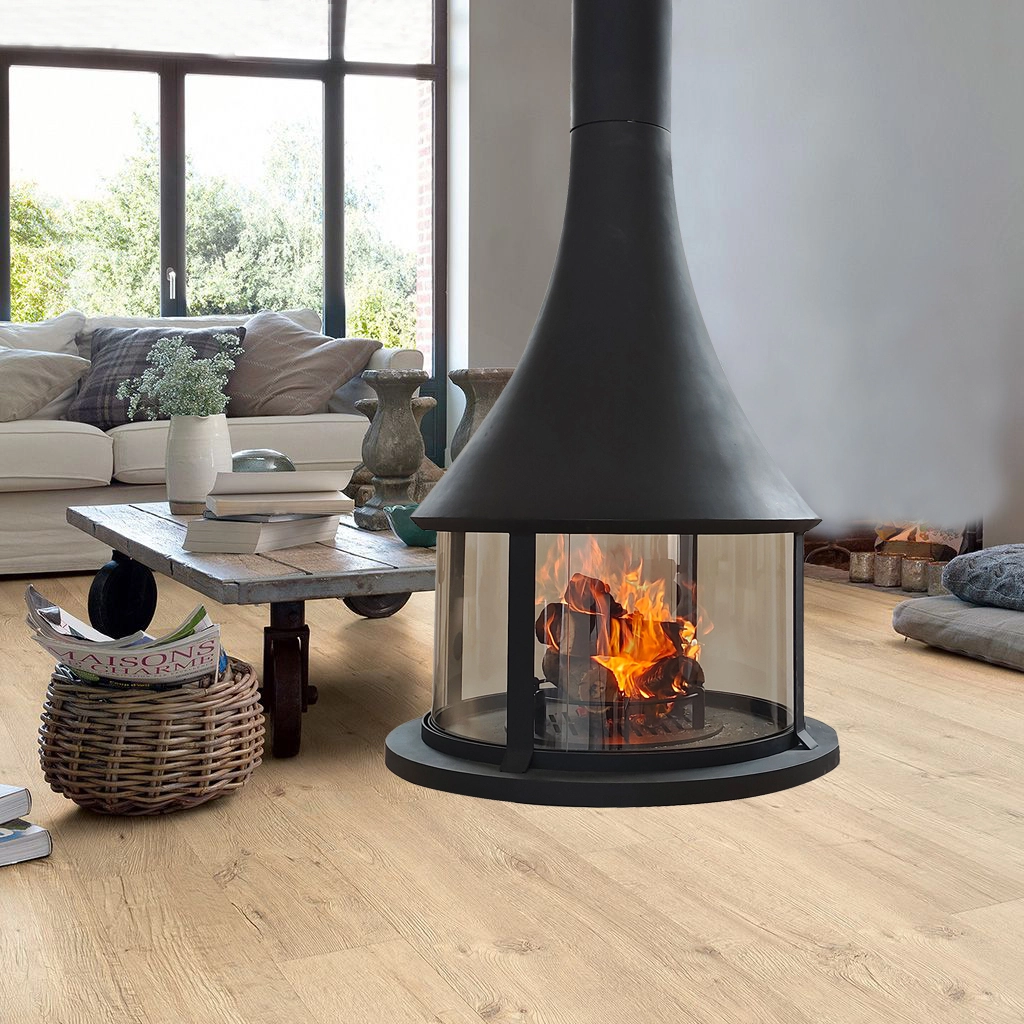
Fire Suspended in the Air: The Fascinating History of Hanging Metal Fireplaces
Throughout human history, fire was always lit on the ground, on a solid foundation, or in a stone hearth built into a wall. For millennia, the principle of the fireplace remained unchanged: it was a heavy, static, and monumental structure. However, in the second half of the twentieth century, when the world was fascinated by post-war modernization and the futurism of the Space Age, a French artist put forward a revolutionary idea — to lift fire from the ground and suspend it in the air.
This is the history of hanging metal fireplaces, which did not begin in engineering laboratories. It started with the fusion of art, philosophy, and metal.
A Rebellious Philosopher and the First Spark
The birth of suspended fireplaces is tied to one man — Dominique Imbert. Imbert was neither an architect nor a professional designer. His life path was remarkably diverse: he studied literature in London and Paris, worked as an ethnologist in Alaska, was an assistant chef in Manhattan, and eventually even earned a doctorate in sociology from the Sorbonne University.
In 1967, after four years of teaching, he decided to radically change his life. He left the warm classroom, settled in the small, medieval village of Viols-le-Fort in the south of France, and opened a metal sculpture workshop in an old, semi-ruined stone house.
The winter turned out to be freezing. To keep warm in his damp workshop, Imbert welded a strangely shaped structure with his own hands from scrap metal and hung it from the ceiling. This model, originally created only for personal use, became the famous Antéfocus — the prototype for the world’s first suspended fireplace.
1968 and the Revolutionary Gyrofocus
Dominique Imbert wanted his fireplace to “touch the sky and descend from the ceiling.” In 1968, parallel to the student and social revolutions taking place in France, Imbert brought his own revolution to the design world and created the iconic model — Gyrofocus.
This was a true shock to the society of that time. The “Gyrofocus” was not just a hanging fireplace — it was the world’s first fireplace capable of rotating 360 degrees. Its organic, teardrop shape, reminiscent of a silhouette of molten metal, was initially met with skepticism. One architect even told Imbert that this product would never sell because people would be afraid of “fire floating in the air.”
However, the skeptics were proven wrong. Imbert’s company, Focus, quickly caught the attention of leading architects. Moving the traditional fireplace from the wall to the center of the room completely changed the principle of interior layout. The fire became mobile, dynamic, and free.
Recognition in World Museums
In the following decades, the hanging metal fireplace transformed from a functional object into high art. The Gyrofocus and its subsequent models (Domofocus, Ergofocus) won numerous international awards.
The suspended fireplace turned out to be such a unique sculptural specimen that it began to be exhibited in the world’s leading museums of modern art:
- In 1998, it was exhibited at the Guggenheim Museum in New York.
- Later, it became part of the permanent exhibitions at the museums of modern art in Stockholm and Bordeaux.
In a 2009 competition held in Italy, where more than 74,000 people voted, the Gyrofocus was named “The Most Beautiful Object in the World,” leaving behind many modern technological and designer gadgets. Genius architects such as Norman Foster and the Snøhetta architectural group utilized these very fireplaces in their projects.
Technological Evolution
The original hanging fireplaces were completely open, which somewhat reduced their thermal efficiency and required strict safety measures. However, over time, the development of technology turned a new page in history.
In the 21st century, along with the tightening of environmental standards, classic models underwent a transformation. Engineers managed to preserve the original, legendary design while equipping the fireplaces with special curved, glass panels (Glazed models). Dual-combustion systems were created, making the fireplaces compliant with Ecodesign requirements. Furthermore, gas and bioethanol-powered models emerged, clearing the way for the hanging fireplace into multi-story city apartments.
Summary
The history of hanging metal fireplaces is a clear example of how a single free idea can shatter the boundaries of traditional architecture. What began in 1967, in a remote village in the south of France as a freezing artist’s attempt at self-preservation, has today turned into a global industry and the ultimate symbol of modern luxury. Dominique Imbert proved that fire, just like human imagination, does not need to be bound to the earth.